
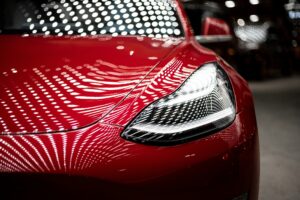




Electric hypercar maker Elon Musk has recently announced that its much-anticipated hypercar, the Tesla Roadster, is being delayed once again. The vehicle was first introduced to the public in 2017 with claims of breaking all of the existing automotive speed records but has yet to appear on Tesla production lines. The latest rescheduling demonstrates the tremendous technical, logistical, and financial challenges to getting a project this scale from the prototype to the public road.
It’s not a shocking surprise to automotive analysts or reservation holders. It’s a strategic decision on how to operate that puts infrastructure on the performance front burner, where it belongs.
The first is Production Timeline: History of Adjusted Targets
The Roadster was also revealed in 2017, when it was driven out of the back of a Tesla Semi, with a production goal of 2020. But there have been ongoing changes over the years. The emphasis shifted from the supercar to the vital manufacturing challenges for the Model 3, before moving on to the model Y and Cybertruck, which will be capital-intensive.
In reality, car manufacturers are forced to stop making a car when there is a global shortage of supply for a specific component, and the first car to be subject to this will not be one of the standard models, but rather a car aimed at extreme performance and brand prestige, a “halo car”. The engineering resources required to develop a hypercar are disproportionate to the revenue that it generates. Instead, Tesla has methodically directed its best engineering resources at building out its self-driving systems and energy storage business, and not finishing a low-volume sports car.
Engineering the SpaceX Package: Physics and Homologation
One of the major reasons given for the long development time is the use of cold gas thrusters, dubbed the “SpaceX Package” by Musk. The technologies developed for the aerospace arena are a new challenge for the automotive industry.
There are several extreme technical challenges that need to be solved to make this a reality:
- Structural Stress Management: Composites chassis designs are notoriously hard to efficiently manufacture at scale and consequently can generate a large amount of G in a very short amount of time, as the 0-60 is under 2 seconds.
- At such extreme output levels, there is a lot of heat created, especially with a multi-motor configuration. Engineers are obliged to completely revamp Tesla’s normal cooling system loops to stop battery and motor degradation during extended track use.
- Global Homologation: When a vehicle is fitted with compressed air thrusters behind its license plate, there are significant regulatory challenges. The extremely high pressure composite tanks installed on board must pass safety tests and crash tests, and the process of co-developing with transportation authorities around the world is long.

200 kWh Packaging Dilemma 3 Battery Architecture
The Tesla Roadster demands a big 200 kWh battery pack to deliver the promised 620-mile range and the huge energy consumption of the motors. The capacity is about twice that of a conventional long range electric vehicle.
When it comes to cramming a ton of storage into a low-slung, aerodynamic sports car chassis, it becomes a serious packaging problem. Moreover, the company’s entire production line is very much dependent on its structural 4680 battery cells production. The optimisation of these cells in terms of yield and energy density needs to be extremely efficient before the company decides to invest the resources in the creation of a specialised hypercar rather than a highly profitable consumer car.
Changing Electric Hypercar Market
At the time the new Roadster was being announced it was in a very peculiar position: it had almost no competition at all. The electric hypercar market was virtually unheard of. But, the delay has come at a price to Tesla’s first-mover advantage in this super-premium segment.
The market is now well developed. There are specialized manufacturers filling in the gap. Such cars as the Rimac Nevera and the Pininfarina Battista are available to customers now, which has already demonstrated that multi-million-dollar electric performance is a reality today. Tesla is no longer competing against the Bugatti or Koenigseggs and their much loved IC engines, it’s now against the dedicated manufacturers of electric hypercars, who have already cracked the extreme performance equation and provided the vehicles.
The delays are ongoing and pose a complex customer relations dilemma for Tesla. A lot of early adopters made significant up-front investments years ago. A $50,000 wire transfer was needed for a standard model, and a full up-front payment of $250,000 was needed to secure a one of the limited Founder’s Series models.
Tesla customer base is already renowned for its brand loyalty and patience, but put hundreds of millions of dollars in customer capital into a company for almost ten years without ever producing a physical product and you’re bound to test consumer confidence. These are the people who are essentially lending the company money without any interest. They are waiting for the company to find a breakthrough in its engineering, and it’s always just out of reach.
The Tesla Roadster problem is a great example of the fact that engineering a prototype is significantly different than scaling a production line. The Roadster will sit on the launch pad until the physics of the SpaceX package matches the economics of mass production. Tesla’s focus right now is on world volume and auto. The Roadster will come, but not until the company is able to manufacture it without compromising its business model.